



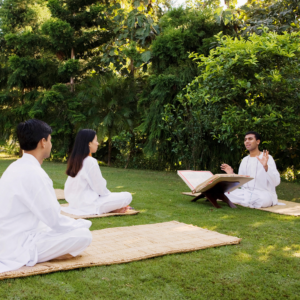
16-year-old Irma Mecele explores how an ancient philosophy may offer solutions to modern problems
Today, young people are increasingly being dragged into a chaotic atmosphere. We are constantly addressed in headlines: climate change, social media, artificial intelligence. Will the planet be preserved for us? Will we be able to find a job? So many unanswered questions cross our minds everyday, often fuelling uncertainty about what the future holds.
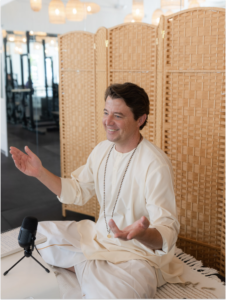
Vedanta practitioner Joseph Emmett.
Amid the mayhem, there are numerous ways to help young people cope with stress. One that I have found particularly interesting is the spiritual philosophy of Vedanta. During the week last December that I spent at the Vedanta Academy in India, I learned more about life than I have in my whole time at school.
The idea that lies at the core of Vedanta is the oneness of existence or, in the words of Joseph Emmett, a practitioner of Vedanta for 30 years, “We is.”
“The existence that we all share, the being that we are all a part of, is singular in the same way that the electricity underlying all bulbs is singular,” Emmett told Harbingers’ Magazine in an exclusive interview.
In other words, although we appear as separate individuals, Vedanta teaches that we share the same underlying existence.
Ancient Indian philosophy
Vedanta is an ancient Indian philosophy based on the Hindu scriptures known as the Vedas – specifically the Upanishads, Brahma Sutras and the Bhagavad Gita. It explores the relationship between the self and reality. Over time, different schools of thought emerged to interpret and teach its ideas.
In the 19th and 20th centuries, Vedanta was revitalised by Sri Ramakrishna and popularised globally by Swami Vivekananda. Vivekananda founded the first US Vedanta society in 1894 in New York, later expanding to San Francisco in 1900, thereby helping introduce the philosophy to the West.
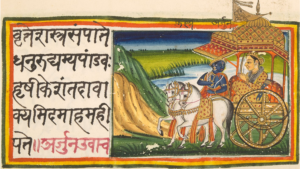
Today, Vedanta continues to be taught internationally. Swami Vivekananda established centres across six continents. There are more than 200 branches in India alone, plus others in countries such as the US, the UK and Japan, offering spiritual guidance, education and community programmes.
One such centre is the Vedanta Academy near Mumbai, founded by Swami Parthasarathy, who taught the philosophy to students from around the world, including Joseph Emmett.
Harbingers’ Weekly Brief
Subscribe to the Harbingers’ Weekly Brief, a newsletter written by the editorial board of Harbingers’ Magazine, the world’s youngest newsroom, delivered to your inbox every Monday morning.
![author_bio]()
![author_bio]()


How to strengthen young minds
Emmett, now 48, began his vedantic journey at the age of 19, feeling “excited and inspired” to uncover the ancient studies of Vedanta. He acknowledges that “a lot of good things for us are not comfortable in the beginning”, but he felt bold enough to take on a new chapter in his life. At the time, he was searching for something he could not fully describe: his purpose.
Emmett says Vedanta has had a positive impact on his life and believes this knowledge should be more widely known. Reflecting on India’s past, he explains: “Vedanta used to be part of the way young people were raised. They were sent to school not only to learn science, maths and geography, but also to gain knowledge of how to live, how to handle life itself.”
He believes Vedanta is a powerful tool to build and strengthen young minds: “A wise person learns from others’ experiences; a fool learns only from their own.”
He gives the example of a pothole in the road: if someone warns you about it, you can avoid damage and trouble. But if you insist on driving into every pothole yourself, life becomes harder and more painful.
“Vedanta is a manual of life and living,” according to Emmett. “Why not read the manual of life early, instead of spending years making mistakes and learning the hard way?”
Emmet continues, “Vedanta encourages us to think and question, not to take things for granted. It suggests we draw on the wisdom of the ancient texts, not by blindly accepting them, but by studying, questioning, living by and testing their teachings, and then accepting or rejecting them based on our own understanding.”
View this post on Instagram
Vedanta offers guidance to everyone, but especially to young people navigating life. However, it requires time and patience to develop one’s intellect, the faculty of clear and independent thinking. As the intellect strengthens, it begins to guide the mind, which governs emotions, allowing a person to become more balanced, controlled, and rational in life.
In this process, Emmett explains that mastering Vedanta happens in two stages: “number one, reflection, thinking about knowledge. And then number two, experimenting with it, which happens automatically.”
Pursuit of success
Many people become attached to success, with a relentless drive towards money and fame. However, Vedanta does not define success in the way it is usually measured, meaning by status, achievements or wealth.

Instead, it defines success “as doing what we ought to do, playing our part in the symphony of life.” No part is too big or too small; each has equal value in contribution. What matters, Emmett explains, is understanding one’s own nature and role.
Vedanta has an alternative approach to success, rather than actively seeking money and fame. “Success will come if you’re doing the thing you’re naturally inclined to do, and that is useful to society,” says Emmett.
You cannot simply decide that you will be successful. What is in your control, he says, is this: “I want to do action based on my make-up, based on my personality, to the best of my ability in the most unselfish way I can.” In this way, Emmet suggests, success will eventually follow.
“Don’t rush it just for the sake of having a certain number of dollars,” he advises. Quick decisions and selfishness will not fulfil your life’s true nature.
The future will remain uncertain, and the headlines will continue to demand our attention. Yet if, as Vedanta teaches, we are “many bulbs lit by the same current”, then perhaps the answer is not fear but understanding – understanding ourselves, our role and how to live wisely in the world we all share.

Edited by:

© 2026 The Oxford School for the Future