



logo

Harbingers’ Magazine is a weekly online current affairs magazine written and edited by teenagers worldwide.

harbinger | noun

har·​bin·​ger | \ˈhär-bən-jər\

1. one that initiates a major change: a person or thing that originates or helps open up a new activity, method, or technology; pioneer.

2. something that foreshadows a future event : something that gives an anticipatory sign of what is to come.

cookie_image

We and our partners may store and access personal data such as cookies, device identifiers or other similar technologies on your device and process such data to personalise content and ads, provide social media features and analyse our traffic.

27 March 2026

Why is Bad Bunny’s Super Bowl show so significant?

author_bio
Lola Kadas in Budapest, Hungary

Article link copied.

slide image

Bad Bunny during his halftime show at the 2026 Super Bowl.

Picture by: Cal Sport Media | Alamy

Bad Bunny’s halftime show at the Super Bowl made historyfor many reasons, including that fact that it was the first halftime show performed only in Spanish and it attracted a record audience of 137.8 million viewers at its peak.

On 8 February, Bad Bunny brought Puerto Rican culture to the world’s biggest stage: the mini-concert held at halftime during the Super Bowl, the annual championship game of the NFL (National Football League), which is watched by millions of viewers.

The artist filled the show with elements from his home country, spreading one main message: “The only thing more powerful than hate is love.”

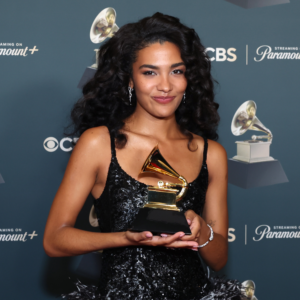
More than 300 dancers took part in the spectacle, while Bad Bunny sang mashups of his biggest hits like ‘Tití Me Preguntó’, ‘EoO’, and songs from his most recent album DeBÍ TiRAR MáS FOToS, which won Album of the Year at the Grammys just a week before.

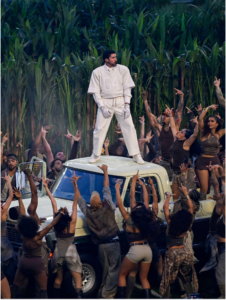
He began the performance by walking through a sugar cane field surrounded by men and women cutting down the stalks, a reference to the central role that the crop played in the territory’s centuries-long colonisation. He was also handed a piragua (Puerto Rican shaved-ice dessert) from a traditional stand.
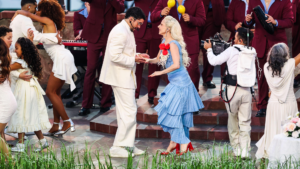
This was followed by other traditional Puerto Rican symbols and concluded with a flag march, which included the flags of all the countries in the Americas and gave his home a special shout-out at the end. Bad Bunny ended the show by holding out an American football with the words “Together, we are America” written on it.

In many previous halftime performances, artists had recited the classic patriotic song ‘God Bless America’, but I saw this as an extension of that gesture and a way of giving it a hopeful new meaning.

This is especially important given that the performance comes 80 years after the US government, which took over the Caribbean island by force at the end of the 19th century, made it illegal to fly a Puerto Rican flag. This, accompanied by the songs and cultural nods, created an environment celebrating pride, patriotism and progress – exactly what the Super Bowl is about.

slide image
  • Lady Gaga was one of the stars to join Bad Bunny on stage.

    Picture by: PA Images | Alamy

  • Lady Gaga and Ricky Martin were among the special guests who shared the stage with Bad Bunny. Others, including Karol G, Cardi B and Pedro Pascal, also participated by being ‘extras’ in a house party-themed part of the show.

    How this reflects US political tensions

    Cooperation is what will bring peace and development everywhere. In light of the recent criticism of US immigration policy, there could not be a better time for a message like Bad Bunny’s.

    Bad Bunny’s performance demonstrated that the US should not be viewed as superior to other countries in the Americas.

    Recent patternsshow that Immigration & Customs Enforcement (ICE) and Customs & Border Protection (CBP) officers have “routinely [gone] far beyond what the law allows them to do” in the US. Many people have opposedthe increased aggression with which these agencies have operated, including some celebrities.

    One of them is Bad Bunny, who began his acceptance speech at the Grammys by saying“ICE out”. That comment, along with the general atmosphere he created during his Super Bowl performance, shows that music and art are political and are some of the most important tools when it comes to spreading messages about love and kindness.

    On my social media feed, I’ve seen many Gen Z feel empowered by Bad Bunny’s message. I like how their voices are being heard on a larger scale. Progress can be difficult, but being motivated and seeing key cultural figures speak out can be the biggest catalyst for change and can unite us all.

    However, we should not try to force popstars to attempt to make a change in politics, but demand development from governments instead. However, it can be seen from President Trump’s response to Bad Bunny’s show, calling it “absolutely terrible”, that this is not always easy.

    I believe that instances where popstars are brave enough to make political statements through their art can not only serve as a moment of hope, but as an ignition of change. And, through his performance, Bad Bunny did exactly that.

    Written by:

    author_bio

    Lola Kadas

    Editor-in-Chief 2026

    Budapest, Hungary

    Lola Kadas joined Harbingers’ Magazine in the summer of 2024 as a contributor during the Oxford pop-up newsroom. After completing the newsroom and writing course, she became a staff writer later that autumn, covering society and public affairs.

    Her strong writing and dedication to the magazine led to her appointment as Society Section Editor in 2025. During this time, she also reported from Bali, Indonesia, where she worked on a special project exploring the local mental health landscape and produced a series of thought-provoking articles.

    Following a successful year in that role, and in recognition of her steady development and commitment, Lola stepped into the role of Editor-in-Chief in 2026, sharing the position with Arnav Maheshwari.

    This will mark the first time the magazine is led by joint Editors-in-Chief, reflecting the growing scope and ambition of the publication. In her new role, Lola will also introduce a fact-checking system to further strengthen the magazine’s editorial standards.

    Born in 2009, Lola has lived in both Budapest, Hungary, and California, United States. She is interested in music, pop culture, politics and mental health. She speaks English, Hungarian, French and Spanish.

    In her free time, she enjoys going to concerts and creating studio art, and is a fan of Taylor Swift’s music.

    Edited by:

    author_bio

    ​​Sofia Vorobei

    Culture Section Editor 2026

    Vergel, Spain

    opinion

    🌍 Join the World's Youngest Newsroom—Create a Free Account

    Sign up to save your favourite articles, get personalised recommendations, and stay informed about stories that Gen Z worldwide actually care about. Plus, subscribe to our newsletter for the latest stories delivered straight to your inbox. 📲

    Login/Register